States With The Highest Rate Of HIV in Nigeria(2024-2026): This article give a breakdown on affected states with HIv prevalence.
In recent Nigeria, there has been a significant increase in the spread of HIV, due to promiscuity. The language of the day has become ( Short time – St and Till day break – TDB) such which is now considered a normal lifestyle for singles and even married people. The worst remains that, individuals now engage in sex without proper protection.
This ha made the journey toward managing and eliminating HIV/AIDS, slightly difficult, but though has seen significant progress, yet the burden still remains unevenly distributed across the country’s 36 states and the Federal Capital Territory (FCT).
As of 2026, Nigeria continues to implement its National HIV and AIDS Strategic Plan, aiming to end the epidemic by 2030.
Understanding which states are most affected is not about creating fear, but about focusing resources and awareness where they are needed most. Here is a comprehensive look at the states with the highest HIV/AIDS presence and how you can stay safe.
The Landscape of HIV/AIDS in Nigeria
According to the latest data from the National Agency for the Control of AIDS (NACA) and the 2024–2025 HIV Spectrum Estimates, Nigeria’s national HIV prevalence stands at approximately 1.2% to 1.4% among adults. While this percentage might seem small, in a country of over 200 million people, it translates to roughly 1.8 to 1.9 million people living with the virus.
Historically, the South-South and North-Central zones have recorded the highest prevalence rates. These “hotspots” are often linked to high-density urban populations, migration, and trade routes.
Top States with the Highest HIV/AIDS Prevalence
This section gives a run through from 2024 to 2026 statistics. If another research is updated in 2026, It will definitely be updated here, for security reasons.
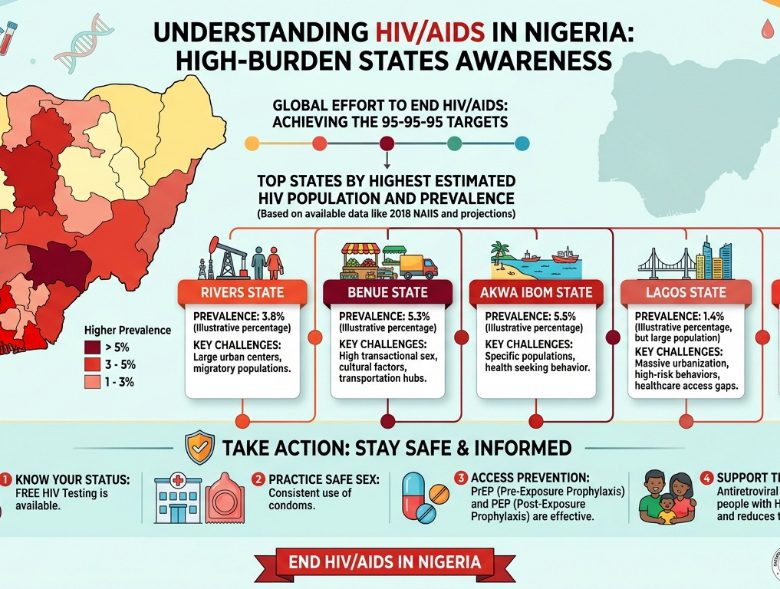
Based on the most recent reports, the following states have the highest number of people living with HIV (PLHIV) and the highest prevalence rates:
1. Rivers State
Rivers State currently holds the highest number of recorded HIV cases in Nigeria, with over 208,000 people living with the virus. As a major industrial and oil-producing hub, the high influx of migrant workers and a large urban population contribute to these figures. However, the state has also intensified its testing efforts, meaning more people are aware of their status and accessing treatment.
2. Benue State
For years, Benue has been at the center of the HIV conversation in Nigeria. It currently records over 202,000 cases, with a prevalence rate significantly higher than the national average (around 4.7% to 5.3% in specific demographics). Cultural factors, transit routes, and historical data points suggest that Benue remains a high-priority area for intervention.
3. Akwa Ibom State
Ranking third, Akwa Ibom has approximately 161,000 cases. Similar to Rivers, its coastal location and economic activities contribute to a mobile population, which can facilitate the spread of the virus.
4. Lagos State
As Nigeria’s commercial nerve center, Lagos has a sheer volume of people that places it high on the list, with about 108,000 cases. While the percentage of the population infected is lower than in Benue, the absolute number of people affected is massive due to the state’s population density.
5. Anambra State
In the South-East, Anambra leads with over 100,000 cases. Data shows that the South-East zone has seen a steady prevalence, particularly among young adults.
Summary Table: High-Burden States (Approximate Figures)
| State | Estimated Number of Cases | Regional Zone |
|---|---|---|
| Rivers | 208,767 | South-South |
| Benue | 202,346 | North-Central |
| Akwa Ibom | 161,597 | South-South |
| Lagos | 108,649 | South-West |
| Anambra | 100,429 | South-East |
| FCT (Abuja) | 83,333 | North-Central |
How to Stay Safe: A Guide for Citizens
This following tips are guidelines from WHO. It important to acknowledge that HIV is preventable, and with modern medicine, it is no longer a “death sentence.” Here is how you can protect yourself and your loved ones:
1. Know Your Status (Testing)
The first step to safety is a test. Many people live for years without symptoms.
- Where to go: Every General Hospital and most Primary Healthcare Centers in Nigeria offer free HIV testing.
- Self-Testing: You can now buy HIV self-test kits at reputable pharmacies.
2. Practice Safe Sex
Unprotected sexual intercourse remains the primary mode of transmission in Nigeria.
- Condoms: Correct and consistent use of male or female condoms is highly effective.
- Faithfulness: Reducing the number of sexual partners and maintaining a mutually monogamous relationship with an uninfected partner lowers risk.
3. Use Prevention Medications (PrEP and PEP)
Science has provided us with powerful “shields” against the virus:
- PrEP (Pre-Exposure Prophylaxis): A daily pill for people who are HIV-negative but at high risk. It prevents the virus from taking hold in the body.
- PEP (Post-Exposure Prophylaxis): An emergency medication taken after a potential exposure (e.g., a broken condom or sexual assault). It must be started within 72 hours.
4. Be Careful with Sharp Objects
Ensure that any needles, barbing clippers, or tattooing equipment used on you are sterile.
- At the Salon: It is safer to carry your own set of clippers or ensure the barber uses a sterilizer/bleach in your presence.
- Medical Procedures: Always ensure hospitals use new, disposable syringes.
5. Protection for Expectant Mothers
If you are pregnant, getting tested is vital. If a mother is HIV-positive, she can take medications that prevent the virus from passing to her baby (PMTCT). This has allowed thousands of HIV-positive parents in Nigeria to have healthy, HIV-negative children.
Support and Treatment: “U=U”
If you or someone you know tests positive, the most important thing is to start Antiretroviral Therapy (ART) immediately.
U=U (Undetectable = Untransmittable): When a person takes their HIV medication consistently, the amount of virus in their blood becomes so low that it cannot be detected by a test. At this stage, they cannot pass the virus to their sexual partners.


 Doctor Brandy Harmon
The rising HIV prevalence in Nigeria is alarming, and it’s great that the article emphasizes the need for focused resources in the most affected states. The situation calls for more education on safe sex and community-based interventions.
You have a great point. Thanks a lot for the reaction
Port Harcourt is becoming something else