New POS Scams in Nigeria: A guide on How to Protect Your Money and Your PIN in 2026
New POS scams in Nigeria: In the last few years, the “POS business” has become the heartbeat of the Nigerian economy. From the busy markets of Onitsha to the tall buildings in Lagos Island and the residential streets of Port Harcourt, you can’t walk ten minutes without seeing a yellow or green umbrella with a “Withdraw Cash Here” sign.
While these POS (Point of Sale) agents have made life easier by bringing the bank to our doorsteps, they have also attracted “bad belle” people; A.K.A – Yahoo boys, who are looking for any way to empty your hard-earned savings. In 2024 alone, Nigeria lost over ₦52 billion to digital fraud, and a huge chunk of this happened through POS terminals.
As we move through 2026, the POS scams in Nigeria, are getting more “coded.” This article will expose the new tricks these scammers are using and show you exactly how to keep your ATM PIN and your money safe.
The New methods of POS Scams in Nigeria and how to protect your ATM
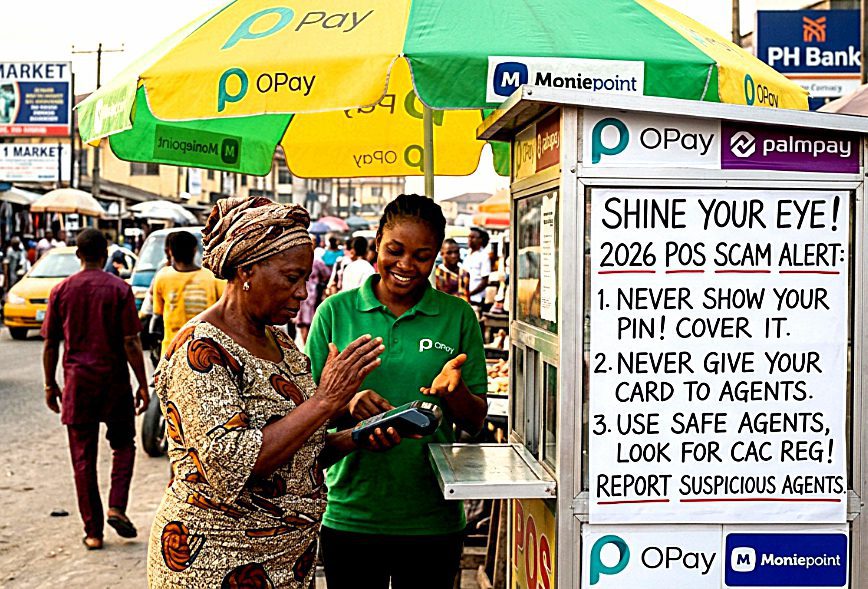
Gone are the days when scammers only used “one-chance” buses. Today, they have entered into POS scams, other technology, and “sweet mouth” to deceive people. Here are the latest ways they are operating:
1. The “Cloned Terminal” Trick
This is one of the most dangerous scams happening right now in places like Ikeja (Lagos) and Wuse (Abuja). Scammers now use machines that look exactly like the ones from OPay, Moniepoint, or Palmpay, but they are “cloned.”
When you insert your card and type your PIN, the machine doesn’t actually process a withdrawal. Instead, it “records” your card details and your PIN. The agent will tell you “Network is bad” or “Transaction Declined,” but they have already stolen your information. Later that night, while you are sleeping, they will use that data to wipe your account.
2. The “Helping Hand” at the Kiosk
In crowded areas like Mile 1 Market in Port Harcourt or Kano’s Sabon Gari, things can get very busy. A scammer might stand near a POS kiosk acting like a customer. If you are struggling with the machine or the agent is distracted, they might offer to “help” you insert your card or “hold” your bag.
While they are “helping,” they are actually memorizing your PIN or even swapping your ATM card with a fake one that looks just like yours. By the time you realize your card is different, they are already at another machine withdrawing your money.
3. The Fake Alert / Reversal Scam
This one is often used against the POS agents themselves, but it affects customers too. Scammers use “SMS spoofing” to send a message that looks like a real bank alert. In other cases, they perform a transaction that seems successful, but because they are using “modified” apps, they initiate a “reversal” immediately after leaving the shop.
If an agent falls for this, they might become desperate and start overcharging other customers or even getting involved in shady deals to recover their lost money.
4. The “Discount” or “Promo” Trap
If you see a POS agent in a place like Lekki or Enugu offering “Zero Charges” or “Cashback on Withdrawals,” be very careful. Some scammers set up temporary stands claiming they are doing a “Bank Promo.” Their real goal is to get as many people as possible to swipe their cards so they can harvest card data. Remember: if it sounds too good to be true, it is probably a scam.
Locations With High Prevalence of POS scam in a Nigeria
While fraud can happen anywhere, certain “hotspots” have been identified by security agencies due to high foot traffic and the large number of unregistered operators.
- Lagos (Lekki, Ikeja, and Lagos Island): Because of the huge amount of money moving here daily, scammers love these areas.
- Port Harcourt (Choba and Mile 1): With many students and traders, these areas are prime targets for card swapping and “declined” transaction scams.
- Abuja (Wuse 2 and Gwarinpa): Fraudsters here often pose as “corporate” agents to gain trust before using cloned machines.
- Onitsha and Aba: The heavy market activity makes it easy for scammers to disappear into the crowd after a successful “Fake Alert” scam.
How to Protect Your ATM PIN and Your Bank Account
Protecting yourself from POS scam in Nigeria, doesn’t require a degree in cybersecurity. It just requires you to be “shine your eye” (staying alert). Here are the golden rules for 2026:
1. Shield Your PIN Like Your Life Depends on It
When typing your PIN, use your other hand to cover the keypad completely. Even if the agent looks like a “Pastor” or an “Alhaji,” do not let them see your fingers. Scammers often place tiny cameras or use “shoulder surfing” to see what you are typing.
2. Only Use Registered Operators
The Corporate Affairs Commission (CAC) and the CBN have mandated that all POS operators must be registered. Look for agents who have a permanent shop or a well-branded kiosk. Avoid “mobile” agents who are just standing on the street corner with a machine and no identification. If they have a CAC certificate displayed, it is a good sign.
3. Watch the Machine
Before you insert your card, look at the POS machine. Does it look tampered with? Is there a strange piece of plastic sticking out? If the machine looks “bulky” or “different” from the usual ones, walk away.
4. Never “Lend” Your Card
Never give your card to an agent to “go and look for signal.” Your card should never leave your sight. If the signal is bad, take your card back and try another place.
5. Set Transaction Limits
Use your bank’s mobile app to set a “Daily Limit” for POS transactions. If your limit is ₦20,000, even if a scammer steals your card details, they won’t be able to empty your account in one go.
6. Use Cardless Withdrawals
Many banks and fintechs like OPay and Moniepoint now allow “Cardless Withdrawals.” You generate a code on your phone, and the agent enters the code to give you cash. This way, you never even have to bring your ATM card out of your wallet!
What to Do If You Have Been Scammed
If you notice a transaction you didn’t authorize, speed is everything:
- Block Your Card Immediately: Use your bank’s USSD code (e.g., 966911# for Zenith or 901911# for Access) or use your mobile app to “Freeze” the card.
- Report to the Bank: Call your bank’s fraud desk or visit the nearest branch.
- Report to the Platform: if it was a Moniepoint or OPay machine, contact their customer support immediately. They can often “trace” which agent’s machine was used.
- Notify the Police or EFCC: For large sums, a formal report is necessary to help track the criminals.
Conclusion
The POS system is a blessing to Nigeria, but we must use it with wisdom. Scammers are working 24/7 to find new ways to steal, so you must also work 24/7 to stay safe. Keep your PIN private, use trusted agents, and always check your alerts.
Stay safe, sweet mum, and keep your money where it belongs—in your pocket!
Frequently Asked Questions (FAQs)
1. Can a POS agent “clone” my ATM card just by swiping it?
Answer: Yes, it is possible. If an agent uses a compromised or “cloned” terminal, the machine can read the magnetic strip or chip data of your card. This is why it is safer to use the “Tap to Pay” (NFC) feature or Cardless Withdrawal c5odes whenever possible, as they don’t share your actual card details with the machine.
2. Is it true that all POS operators must be registered with the CAC in 2026?
Answer: Yes. As of January 1, 2026, the Corporate Affairs Commission (CAC) began enforcing mandatory registration for all POS operators in Nigeria. If you see an agent without a visible business name or registration details, it is a major red flag. Always patronize “branded” points like those from Moniepoint, OPay, or Palmpay.
3. What should I do if the POS machine says “Declined” but I get a debit alert?
Answer:
- Don’t panic: Ask the agent to print a “Declined” receipt. Keep that paper!
- Wait: Most “failed” transactions are reversed automatically by your bank within 24 hours.
- Do not pay cash immediately: If you must pay, ensure you have proof that the first one failed. If the money isn’t back in 24 hours, contact your bank’s customer care on X (formerly Twitter) or through their app.
4. Can a scammer use “AI Voice” to trick me?
Answer: Yes, this is a new trend in 2026. Scammers use AI to mimic the voice of a bank official or even a relative, calling to ask for your OTP (One-Time Password) or PIN to “fix a POS error.” Remember: No bank will ever ask for your PIN or OTP over the phone. If you get such a call, hang up immediately.
5. Is a screenshot of a “Successful Transaction” enough proof of payment?
Answer: No. In 2026, “Fake Alert” apps are very advanced and can create perfect-looking screenshots. For POS agents and customers alike, the only proof of payment you should trust is a confirmed credit in your bank app balance or a physical receipt printed directly from the machine.
6. Why does the agent ask for my phone number or NIN?
Answer: Due to new security regulations in 2026, agents are often required to log the details of large transactions to prevent money laundering and kidnapping ransom payments. While this is normal for high amounts, never give them your PIN or let them take a photo of your ATM card.






 Doctor Brandy Harmon