
Financial Security : See Why Fuel Price Might Hit 1500 Soon (2026)
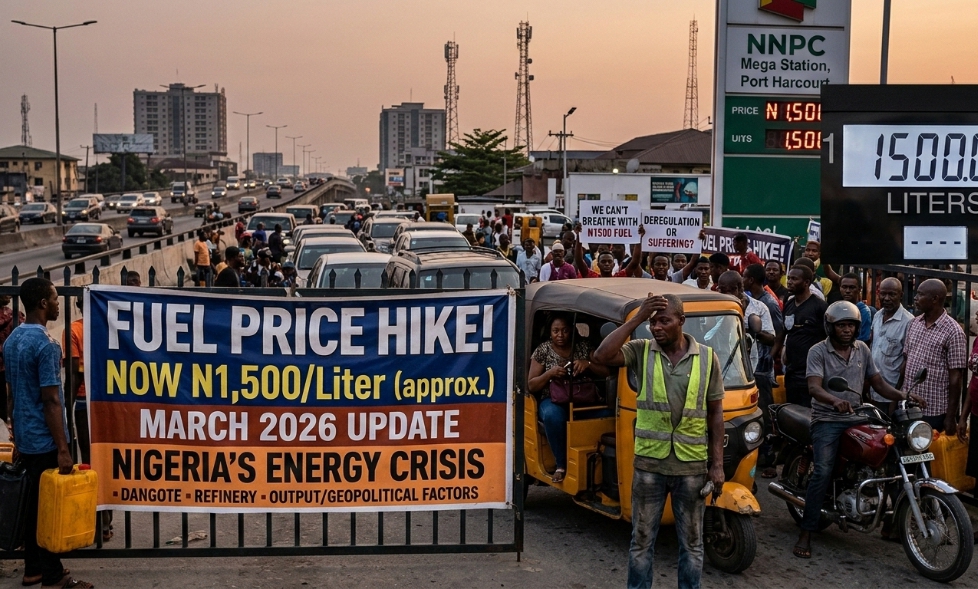
As of early March 2026, Nigeria’s energy landscape is facing an unprecedented shift. Just this week, the Dangote Petroleum Refinery adjusted its gantry price for the fourth time in seven days, pushing the cost of Premium Motor Spirit (PMS) to N1,175 per liter. With independent marketers already retailing between N1,200 and N1,300, the projection that petrol could hit N1,500 by next week is no longer a distant fear—it is a mathematical probability.
Here is an in-depth look at the economic, geopolitical, and logistical forces driving this rapid surge toward the N1,500 mark.
1. The Geopolitical “Triple Threat” in the Middle East
The primary catalyst for the current price spike is the sudden escalation of conflict in the Middle East. As of March 9, 2026, coordinated military actions involving the U.S., Israel, and Iran have sent global oil markets into a tailspin.
- Crude Oil Volatility: Brent crude, which hovered around $70–$80 just weeks ago, has surged past $102 per barrel.
- The “Premium” on Nigerian Crude: Although Nigeria is an oil producer, the Dangote Refinery and other local plants purchase crude at international market rates. Currently, Nigerian crude trades at a $3 to $6 premium over the Brent benchmark.
- Global Supply Tightening: The closure or threat to key shipping lanes, such as the Strait of Hormuz, has restricted the flow of oil, forcing refineries worldwide to compete for dwindling supplies at exorbitant costs.
2. The Realities of a Fully Deregulated Market
In 2026, the Nigerian government has moved entirely away from fuel subsidies. Under this “willing buyer, willing seller” model, the Nigerian Midstream and Downstream Petroleum Regulatory Authority (NMDPRA) no longer fixes prices.
Instead, the pump price is a direct reflection of Market Dynamics. When the cost of the “raw material” (crude oil) goes up globally, the “finished product” (petrol) must follow suit immediately to ensure the refinery can afford to buy the next batch of crude. This is known as Replacement Cost. If a marketer buys fuel at N1,175 today but knows the next batch will cost N1,300, they must raise prices now to stay in business.
3. The “Naira-for-Crude” Paradox
While the government initiated a “Naira-for-Crude” deal to help stabilize prices, the practical execution has faced hurdles:
- International Benchmarking: Even when paying in Naira, the price is still pegged to the global Dollar value of oil.
- Feedstock Shortages: Reports indicate that domestic producers have struggled to meet the full crude requirements of local refineries. This has forced the NNPCL to source crude through third-party international traders, who add their own margins and “risk premiums,” further inflating the landing cost.
4. Surging Logistics and Freight Costs
The cost of moving fuel is not just about the fuel itself; it’s about the ships and trucks that carry it.
- Maritime Freight: Global tanker rates have seen a massive jump. The cost of a single shipment has reportedly risen from roughly $800,000 to over $3.5 million due to increased insurance premiums in conflict zones and higher demand for available vessels.
- Domestic Distribution: In cities like Port Harcourt and Lagos, the cost of diesel (AGO)—which powers the trucks transporting petrol—has hit N1,620 per liter. This creates a “double-tax” on the consumer: as diesel prices rise, the cost of delivering petrol to your local filling station rises with it.
5. Panic Buying and Speculative Hoarding
Whenever a price hike of this magnitude is predicted, a psychological factor takes over.
- Supply Gaps: Speculation that prices will hit N1,500 leads some depot owners to temporarily suspend loading to “reassess” their pricing. This creates an artificial scarcity.
- The Scramble: When consumers see long queues forming, they rush to fill their tanks, which empowers independent marketers to push retail prices toward the N1,500 ceiling even before their actual costs increase.
Summary Table: The Road to N1,500
| Global Brent Crude | Over $102/barrel | High Upward Pressure |
| Dangote Gantry Price | N1,175/liter | Baseline for Marketers |
| Diesel (Truck Fuel) | N1,620/liter | Increases Delivery Cost |
| Shipping/Insurance | Up 200%–500% |
Things to expect next week
If the Middle East conflict does not de-escalate within the next 48 to 72 hours, the Petroleum Products Retail Outlets Owners Association (PETROAN) has warned that petrol could not only hit N1,500 but potentially move toward N2,000 in extreme scenarios. For the average Nigerian, this means preparing for a significant increase in transport fares and the general cost of living.
The surge of petrol prices toward N1,500 per liter is not just a number on a filling station billboard—it is a “tsunami” that hits every kitchen and commute in Port Harcourt. As of March 9, 2026, with the Dangote Refinery gantry price already at N1,175 and diesel at N1,620, the ripple effect is immediate.
Here is a breakdown of how this hike specifically impacts food costs and transportation.
1. The Impact on Transportation
In Port Harcourt, transportation is the “nervous system” of the economy. When fuel goes up, the cost of moving people and goods follows within hours.
Skyrocketing Commuter Fares
For residents moving from Choba to Garrison or Mile 1 to Borokiri, the daily commute is becoming a luxury.
- Intra-city Hikes: Short trips that previously cost N400 are already being adjusted to N700 or N800. If petrol hits N1,500, we can expect standard “drops” to double.
- Tricycle (Keke) & Bike Pressures: Keke riders, who are the backbone of inner-street transit, are hit hardest. Because their tanks are small, they feel the “daily” price fluctuations instantly, often leading to heated arguments with passengers over new fares.
Logistics and Inter-state Travel
Moving goods from the Onne Port or the Oil Mill Market to other parts of the state requires heavy-duty trucks powered by diesel. With diesel now at N1,620, the cost of hiring a delivery van or truck has increased by roughly 35%–50% this week alone.
2. The Impact on Food Prices
There is a saying in Nigerian markets: “Petrol has no mouth, but it eats everything.” Food prices in Port Harcourt are heavily dictated by the cost of “landing” those goods at markets like Mile 1, Creek Road, or Oil Mill.
The “Farm-to-Table” Tax
Most of the tubers (yam, cassava) and grains (rice, beans) consumed in Port Harcourt come from the Middle Belt or northern regions.
- Increased Freight: A truck driver bringing yams from Benue to Port Harcourt now spends nearly double on fuel compared to last month. To break even, he must charge the traders more.
- The “Trader’s Margin”: When a trader at Mile 1 Market pays N200,000 for a truckload instead of N120,000, she spreads that cost across every single tuber of yam. This is why a single yam that cost N1,500 last week might hit N2,200 by next Monday.
Perishables and Cold Storage
Port Harcourt’s seafood and poultry sectors rely on cold storage.
- Generator Dependence: Many cold rooms use petrol or diesel generators to bypass unstable grid power. As fuel hits N1,500, the cost of keeping fish, turkey, and chicken frozen rises.
- Price Spikes: Expect a “frozen food tax” where a kilo of chicken increases by N500–N800 simply to cover the cost of the electricity needed to keep it from spoiling.
3. Comparative Cost Analysis (March 2026)
| Category | Price (Feb 2026) | Projected (Next Week @ N1,500 Fuel) | % Increase |
|---|---|---|---|
| Transport (Mile 1 to Choba) | N800 | N1,400 – N1,600 | ~100% |
| Loaf of Bread | N1,200 | N1,600 | 33% |
| Paint Bucket of Garri | N3,500 | N4,800 | 37% |
| Kilo of Frozen Chicken | N4,500 | N5,500+ | 22% |
4. The Social Ripple Effect
Beyond the wallet, this hike changes how people live:
- “Trekking” as a Trend: More residents are choosing to walk short-to-medium distances to save money for food.
- Bulk Buying Decline: As prices become unpredictable, people are buying less at a time, which ironically makes things more expensive as they lose out on “bulk discounts.”
- Small Business Strain: For those running food businesses (like “Pluto Kitchen” or local eateries), the choice is brutal: raise prices and lose customers, or keep prices the same and go out of business.
The jump to N1,500 is more than a policy shift; it is a fundamental restructuring of the Port Harcourt household budget.
Must do
Vdm.ng advices the public to purchase enough petrol, should in case a fuel scarcity emerges next week( 15th March, 2026 ).





 Doctor Brandy Harmon